Patios in Wicklow, for sloping sites, sea air and shaded gardens.
We are patio contractors working across Wicklow, from Bray, Greystones, Wicklow town and Arklow on the coast to Blessington, Rathdrum and the villages in the hills. Wicklow gardens are rarely flat and often damp, so a patio here is planned around the slope, the weather off the sea and how slippery the stone gets in shade.
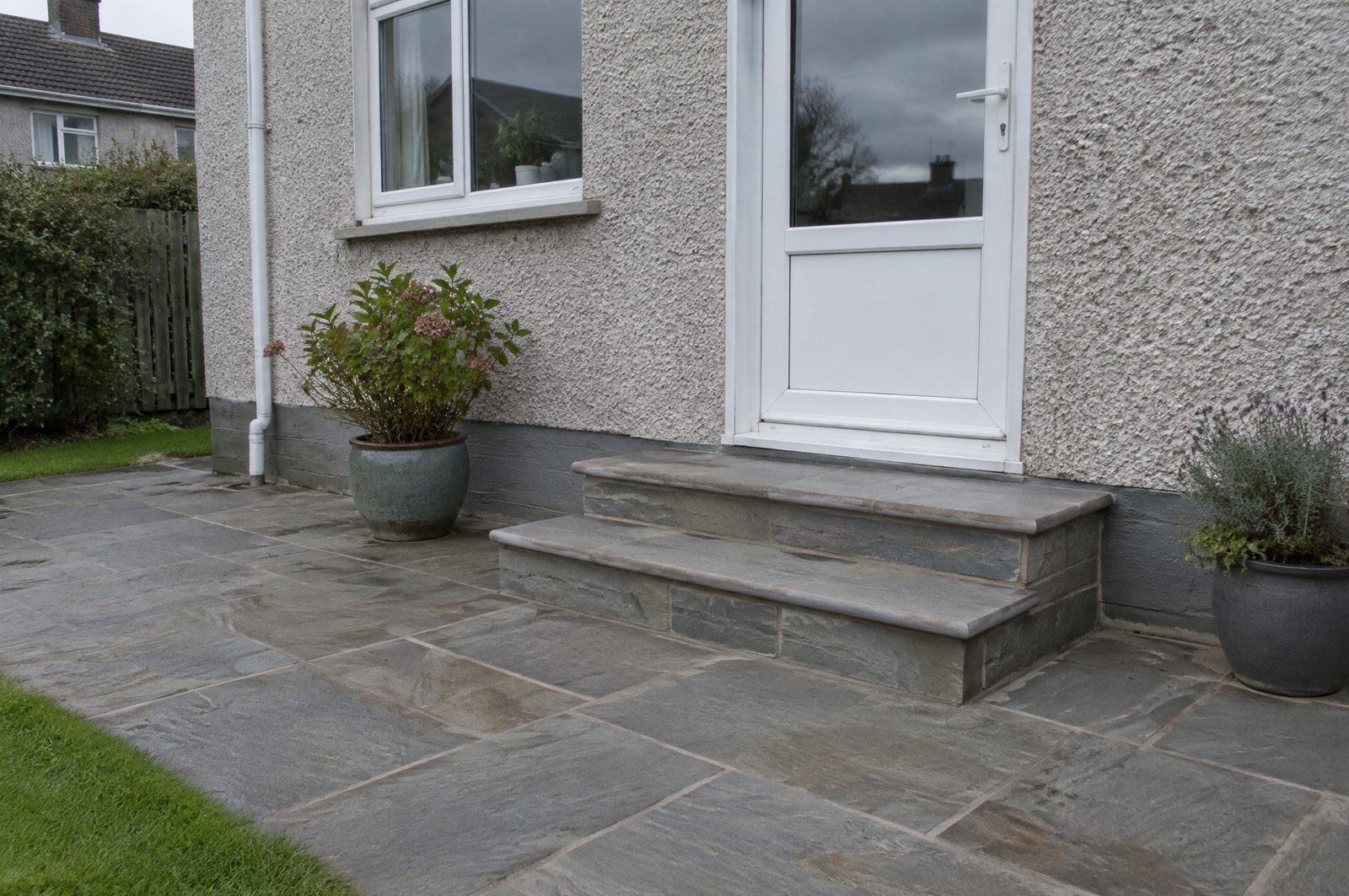
Most Wicklow patios have to deal with a slope, which means cutting in, building up, and adding steps or a retaining edge so the patio sits level.
On the coast the stone and joints face salt and wind; in shaded gardens they face constant damp, so the finish has to give grip when wet.
Every slab goes on a full mortar bed over compacted Type 1, the site visit is free, and the written quote follows within 48 hours.
Patios on sloping Wicklow sites.
Much of Wicklow is built on a hillside. Houses in Bray and Greystones climb away from the sea, the towns inland sit in valleys, and plenty of back gardens rise or drop steeply from the kitchen door. A level patio on a slope means one of two things: cutting into the high side and holding back the soil above, or building up the low side and holding up the patio itself. Often it is a bit of both.
Either way the edge has to be retained. A low wall, a raised kerb or a stepped edge in matching stone keeps the bank from sliding onto the patio and keeps the sub-base from creeping out of the low side. Steps link the patio to the lawn or the garden above, laid with the same stone so the treads match. That is landscaping work, and the same crew does it alongside the patio so the levels, falls and finishes join up.
On a slope the falls need extra thought. Water running down the garden towards the house has to be caught before it reaches the patio, usually with a channel at the top edge, and the patio itself still falls away from the house wall.
Salt air and wind on the coast.
Along the coast from Bray down through Greystones and Wicklow town to Arklow, gardens take salt spray and wind for much of the year. A porous stone soaks up salty water, and over time it can show a white bloom on the surface as the salt dries out. Sealing natural stone after laying slows that down, and porcelain, which absorbs almost nothing, avoids it.
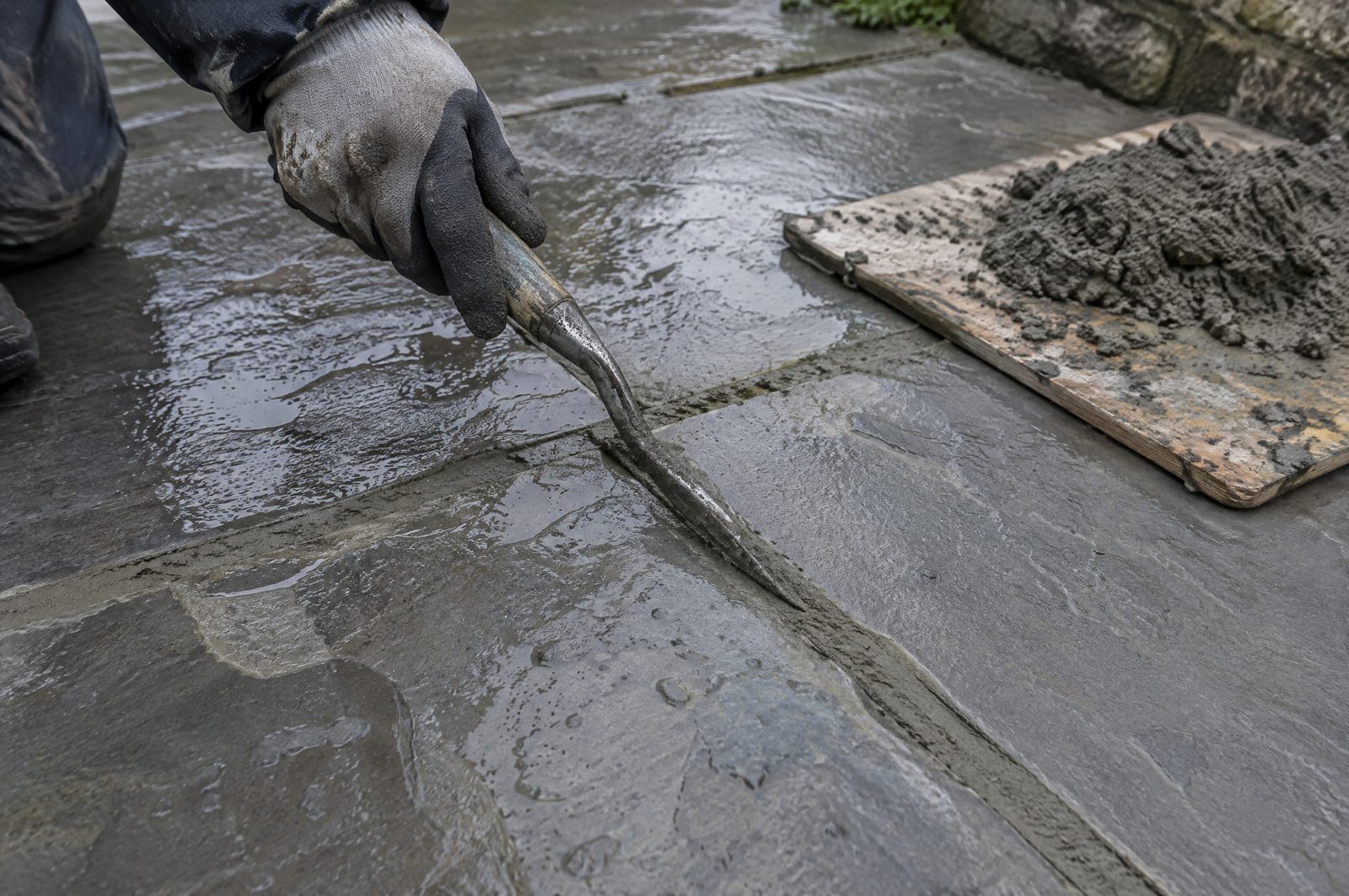
Wind matters for the joints. Kiln-dried sand in a wide joint blows and washes out on an exposed site. On the coast we use polymeric jointing compound or a wet grout so the joint is set hard. Wind also decides where people sit: a patio tucked against the house or behind a wall gets used far more than one out in the open facing the sea.
Granite and the Wicklow look.
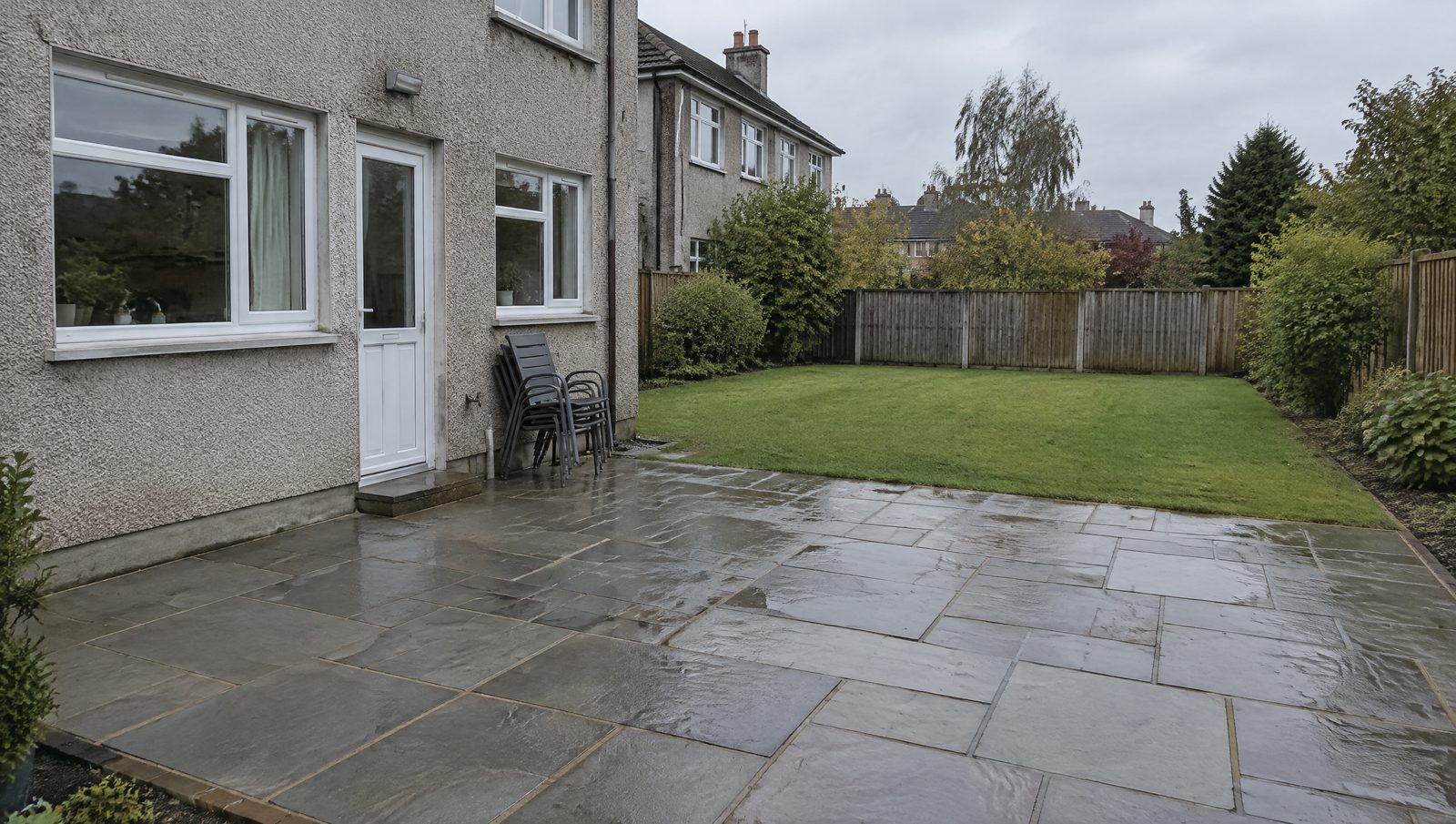
Granite is the stone of the Wicklow hills, seen in old walls, gateposts and buildings across the county, and many people want a patio that sits with that. A grey or silver granite looks at home beside an older stone house or a granite boundary wall. It is also the hardest wearing of the stones we lay, it copes with frost and salt, and a textured finish gives it good grip.
Granite comes in many shades, from near white to dark grey, and in several finishes. We bring samples on the site visit so you can hold them against your walls and see what fits.
Shaded, wet gardens and slippery stone.
Many Wicklow gardens get little direct sun: north-facing gardens on a hillside, gardens in the shadow of trees in a valley, and narrow strips behind houses on steep roads. Stone in shade stays damp, and damp stone grows algae and moss, which make a smooth surface treacherous in the wet. This is the part of patio planning people most often get wrong.
In a shaded garden the choice of finish matters more than the colour. Riven Indian sandstone has a naturally uneven face that holds a foot better than a sawn, smooth slab. Textured granite grips well. Porcelain comes in finishes with a raised texture designed for outdoor use, and the smooth indoor-style finishes are best avoided outside in shade. Smooth limestone is the least suited to a wet, shaded patio. Good falls help too: a patio that sheds water quickly dries faster and grows less.
From the call to the photos.
The same crew looks at the job, quotes it and does it. You get before and after photos when it is finished.
- First01.
Free site visit.
We measure the slope, check the levels at the door and the drains, note the sun and exposure, and bring samples of stone with a grip finish.
- Then02.
Quote in writing within 48 hours.
It sets out the patio, any steps or retaining edge, the sub-base, the falls, the stone and finish, and the jointing.
- Next03.
Dig, retain and lay.
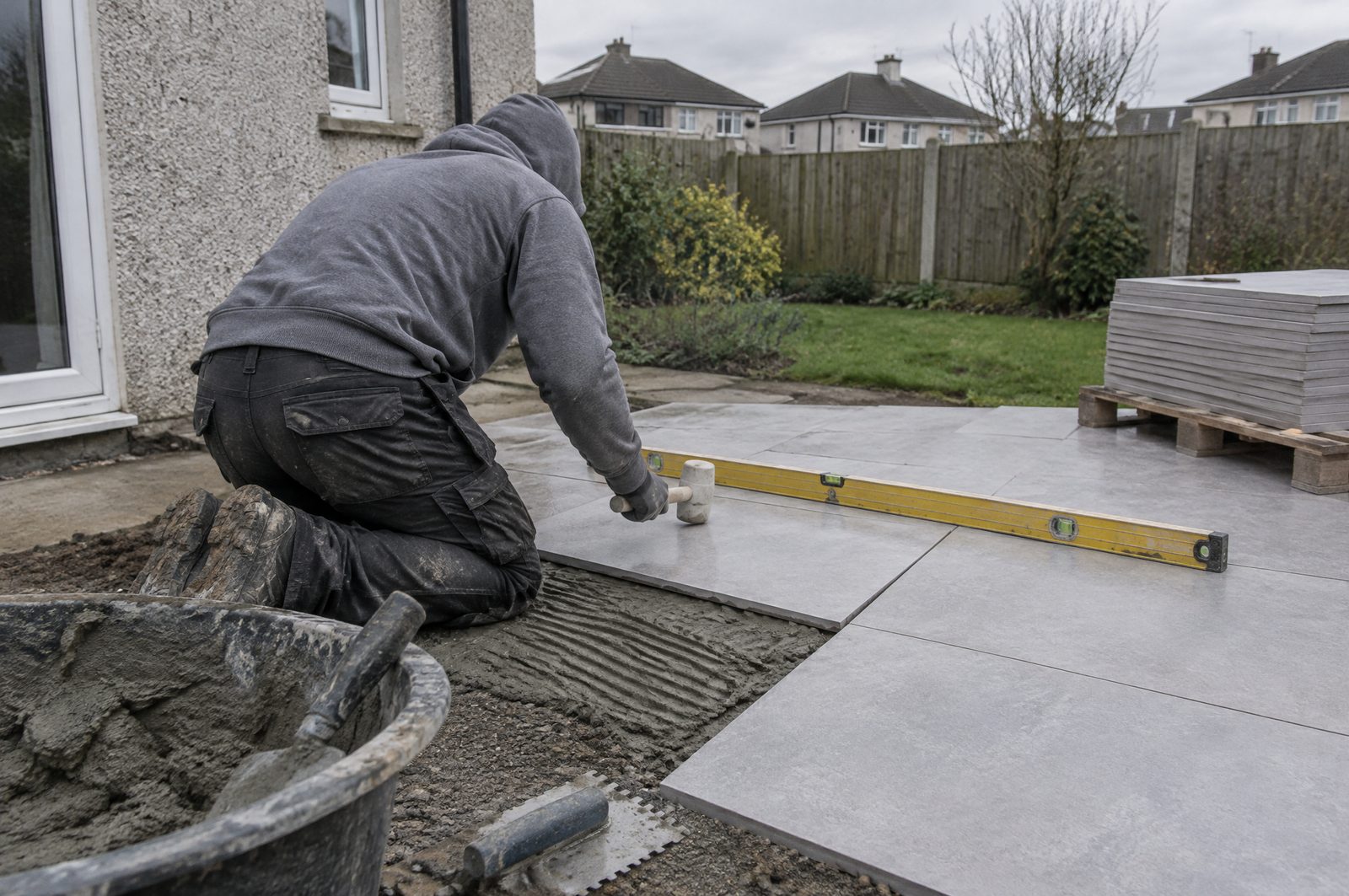
Cut and fill to level, edges retained, Type 1 compacted in layers, and every slab bedded on full mortar.
- Last04.
Joints, wash-down and photos.
Joints finished for the exposure, the patio pressure-washed, waste removed, and before and after photos sent on completion.
Where we draw the line.
We build patios in sandstone, porcelain, granite, limestone and block, with the steps and low retaining edges around them. We do not lay decking. The retaining edges we build are low ones; a tall wall holding back a large bank is a separate structural job. A patio laid on sand alone or on mortar dabs is not something we offer at any price.
Patios questions.
Anything else, ring 085 781 4603.
My garden slopes up from the house. Can you put a patio in?
Yes. The high side is cut back and held with a low retaining edge, and steps go up to the rest of the garden. A channel at the top edge stops water from the slope running across the patio to the house.
What patio stone is least slippery in a shady garden?
A textured finish: riven Indian sandstone, textured granite, or porcelain made with an outdoor grip texture. Avoid smooth sawn stone and polished finishes in shade. Good falls help the surface dry.
Does sea air damage a patio?
It can mark porous stone with salt and wear out sand-filled joints. Sealing natural stone, using porcelain or granite, and setting the joints hard all help on a coastal site.
Is granite a good choice for a patio in Wicklow?
Often, yes. It is hard wearing, it handles frost and salt, and a grey granite sits well beside the stone walls and older houses common in the county. A textured finish gives it grip in the wet.
How long before we can use the patio?
Keep off it for a day or two while the mortar goes off, longer in cold weather. Furniture can go on once the joints have set, and we tell you when on the day.
More on patios.
Or go back to the main patios page.
Get your job priced properly.
Tell us what needs doing and where. Free site visit, then one written price inside 48 hours, with no pressure to go ahead.