Roof valley repairs: why valleys leak and how they are fixed.
A roof valley is repaired by finding which part has failed, the liner, the cut slates or tiles beside it, or a blockage, and then clearing it, patching it or relining it. A valley carries the water from two slopes at once, so a small fault there turns into a leak quickly. Here is how valleys are built, how they fail, and what each repair involves.
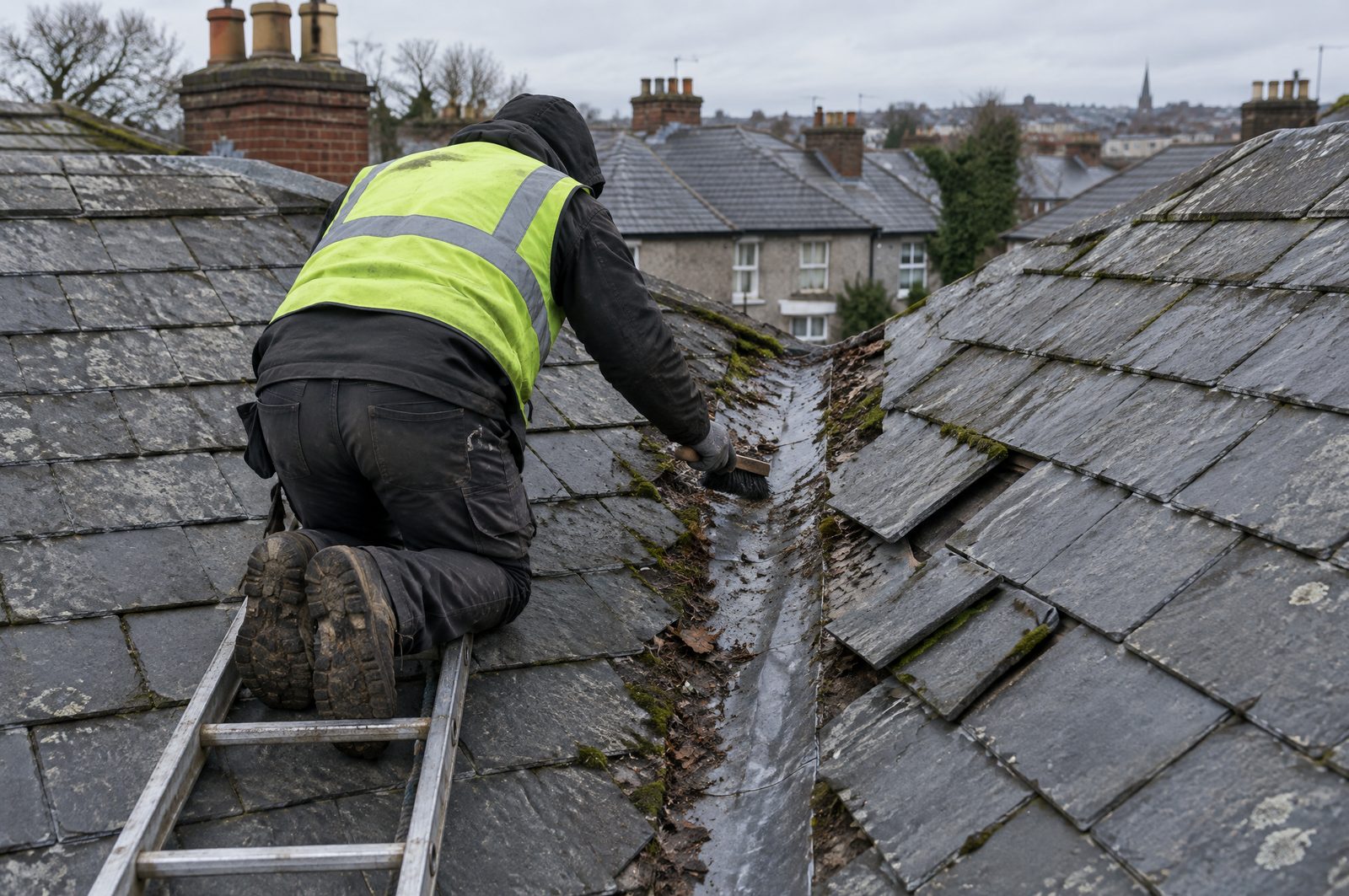
A valley is the internal angle where two roof slopes meet, and it channels the water from both down to the gutter.
Valleys leak when they are blocked with moss and debris, when the lead or GRP liner splits or is too narrow, or when the cut slates or tiles beside it slip and let water run under.
A blocked valley is cleared, a small split in sound lead can sometimes be repaired, and a liner that has failed along its length is relined, which means lifting the covering either side.
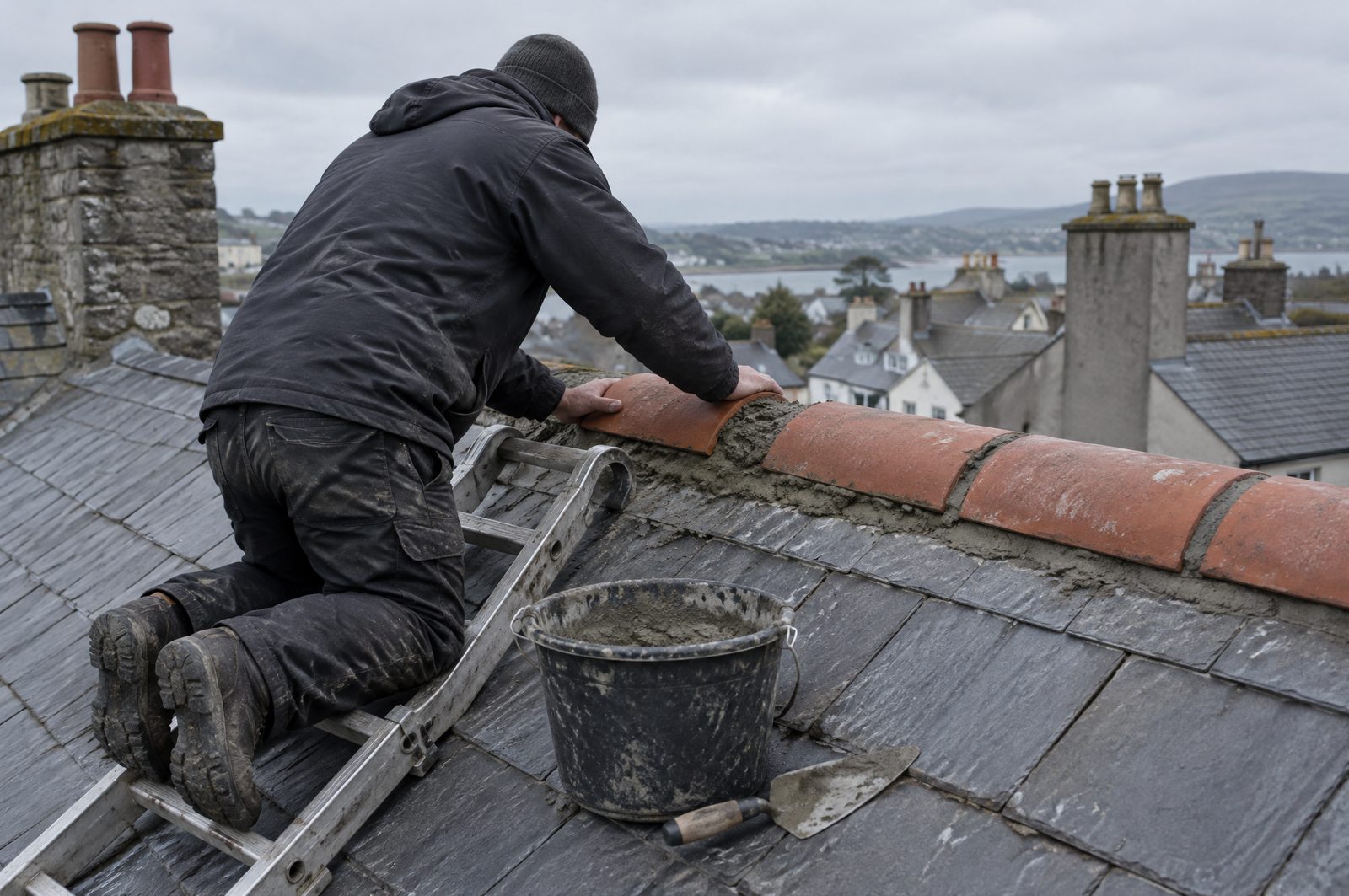
How a valley is built.
There are two broad kinds. In an open valley, the slates or tiles stop short of the centre on each side and leave a visible channel down the middle. The channel is lined with something waterproof laid on valley boards: traditionally milled lead, and on many newer roofs a preformed GRP (glass-reinforced plastic) valley tray. Concrete interlocking tile roofs on Irish estates usually have an open valley, either in lead or a GRP tray.
In a closed valley, the covering continues across the valley and meets in the middle, so no channel shows. On slate roofs this can be a mitred valley, where slates are cut to meet in a line with lead soakers under each course, or a laced or swept valley, where slates are worked round the curve. Plain clay tiles can use purpose-made valley tiles. Closed valleys look neat but are skilled work, and when they fail the repair is too.
Whatever the type, under the liner there should be valley boards and an underlay. Those boards carry the weight of the lead or tray, and if they rot, the liner sags and water pools.
Why valleys leak.
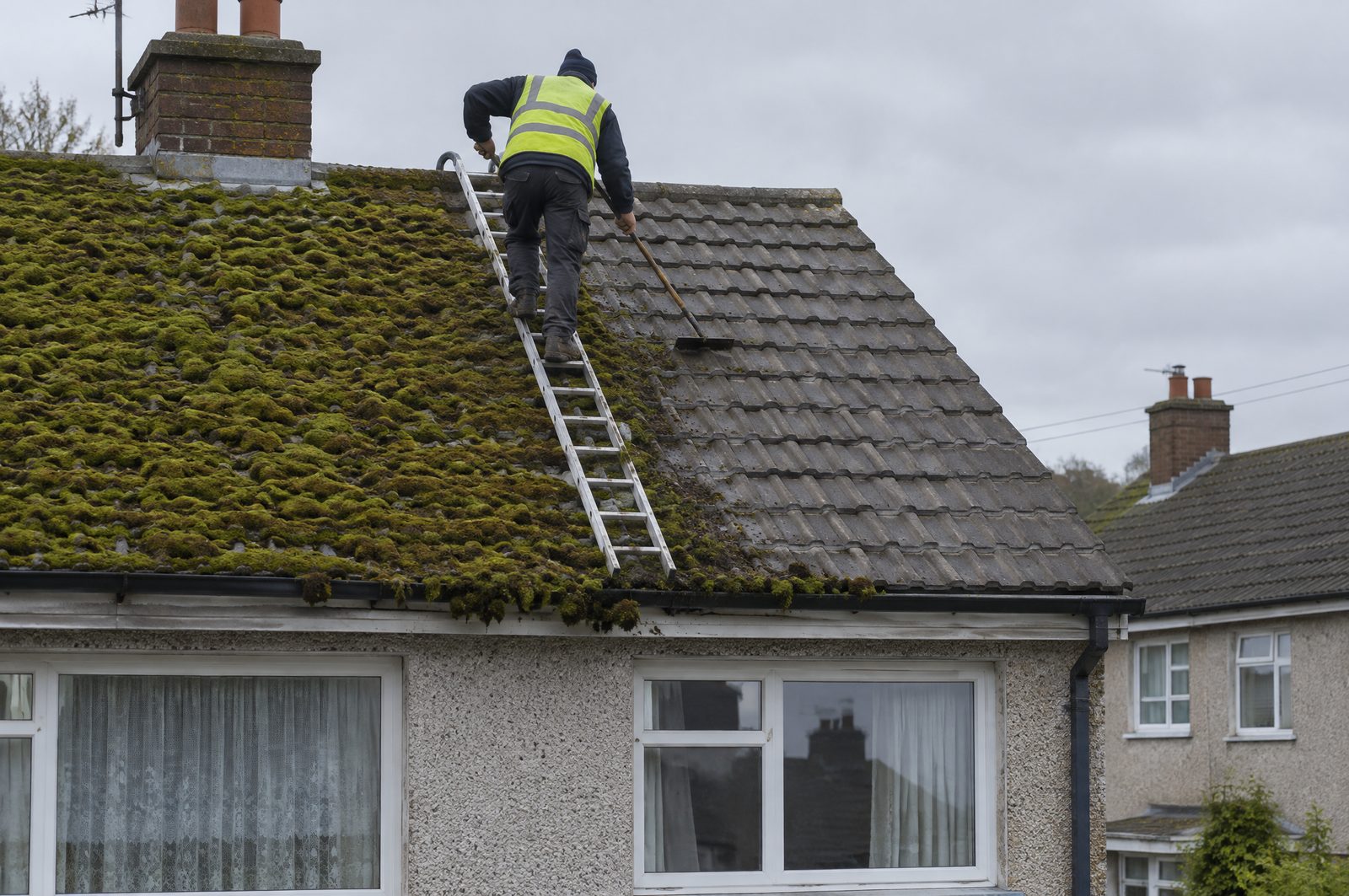
A blockage is a frequent cause. Moss from both slopes washes into the valley, along with leaves and grit, and builds a dam. Water that should run down the channel backs up sideways and gets under the edge of the cut slates or tiles. It shows up as a leak in heavy rain that stops when the rain eases.
The liner fails next. Lead expands and contracts with heat, and a valley laid in lengths that are too long, or nailed through the water path, or with laps that are too short, cracks along a fold or tears at a fixing. Lead guidance limits each length of valley lining, commonly to about one and a half metres, with laps running downhill so water cannot get behind them. Older valleys were sometimes laid in long single pieces, and those crack with age. GRP trays can crack where they have been walked on or where the tray was too narrow for the roof.
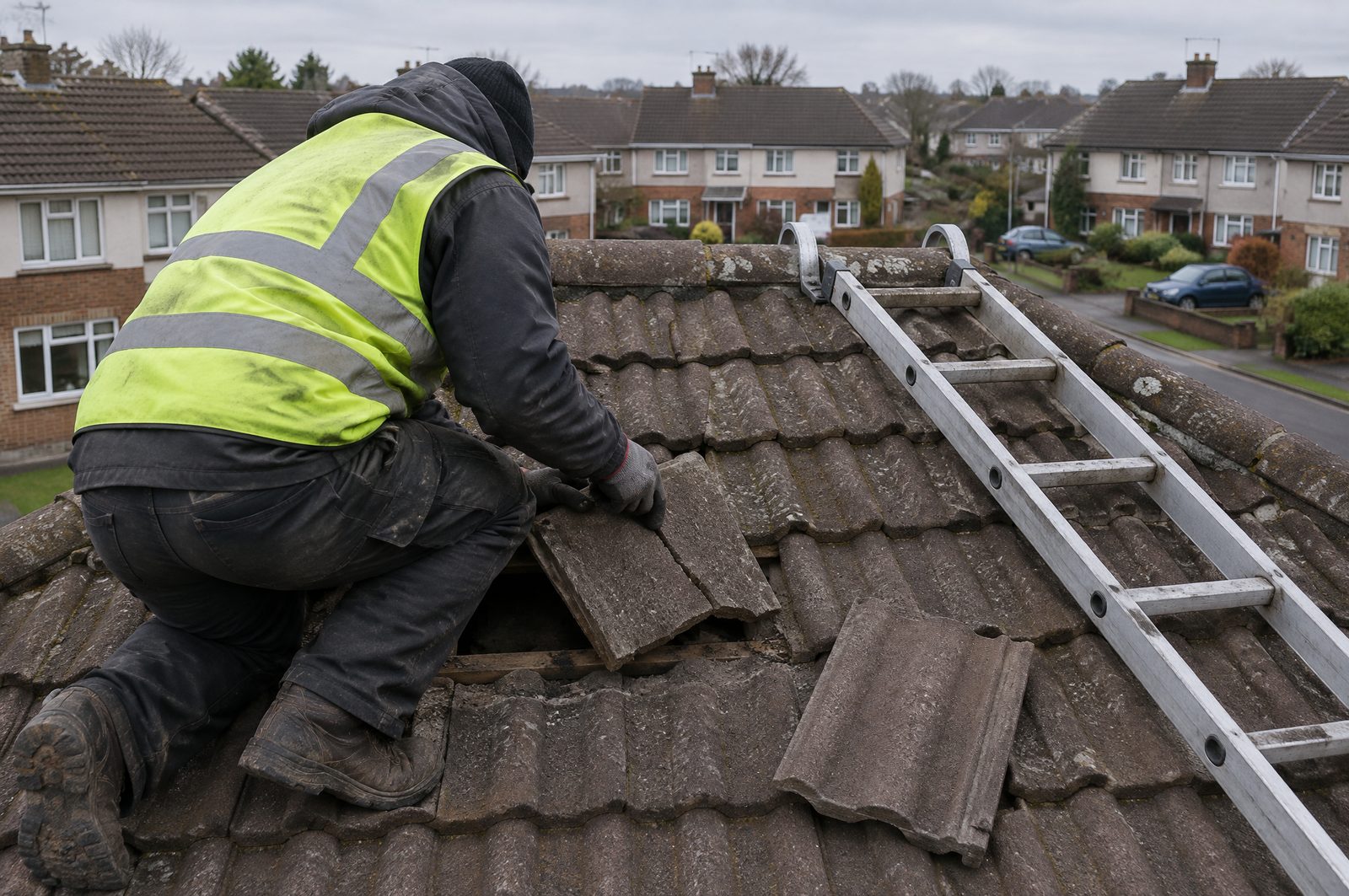
Then the edges. The slates or tiles cut along each side of an open valley sit on a bedding or a fixing that can fail, and once a cut piece slips, water gets into the gap between the covering and the liner. On closed valleys, a missing soaker or a slipped mitre slate lets water straight through.
Finally, width. A valley channel that is too narrow for the area of roof draining into it overflows its edges in a downpour even when nothing is broken.
Signs of a valley problem.
From inside and from the ground, a valley fault usually shows like this.
- 01A stain on a ceiling or wall below the line where two roofs meet, such as an extension joining the main house or an L-shaped roof
- 02Water in the loft along the valley rafter, showing as a dark line on the boards or felt
- 03Moss, leaves or grit visible in the valley from the ground
- 04Slates or tiles along the valley edge out of line or missing
- 05Water pouring over the gutter at the bottom of the valley in heavy rain
- 06Lead in the valley that looks lifted, creased or patched with sealant or tape
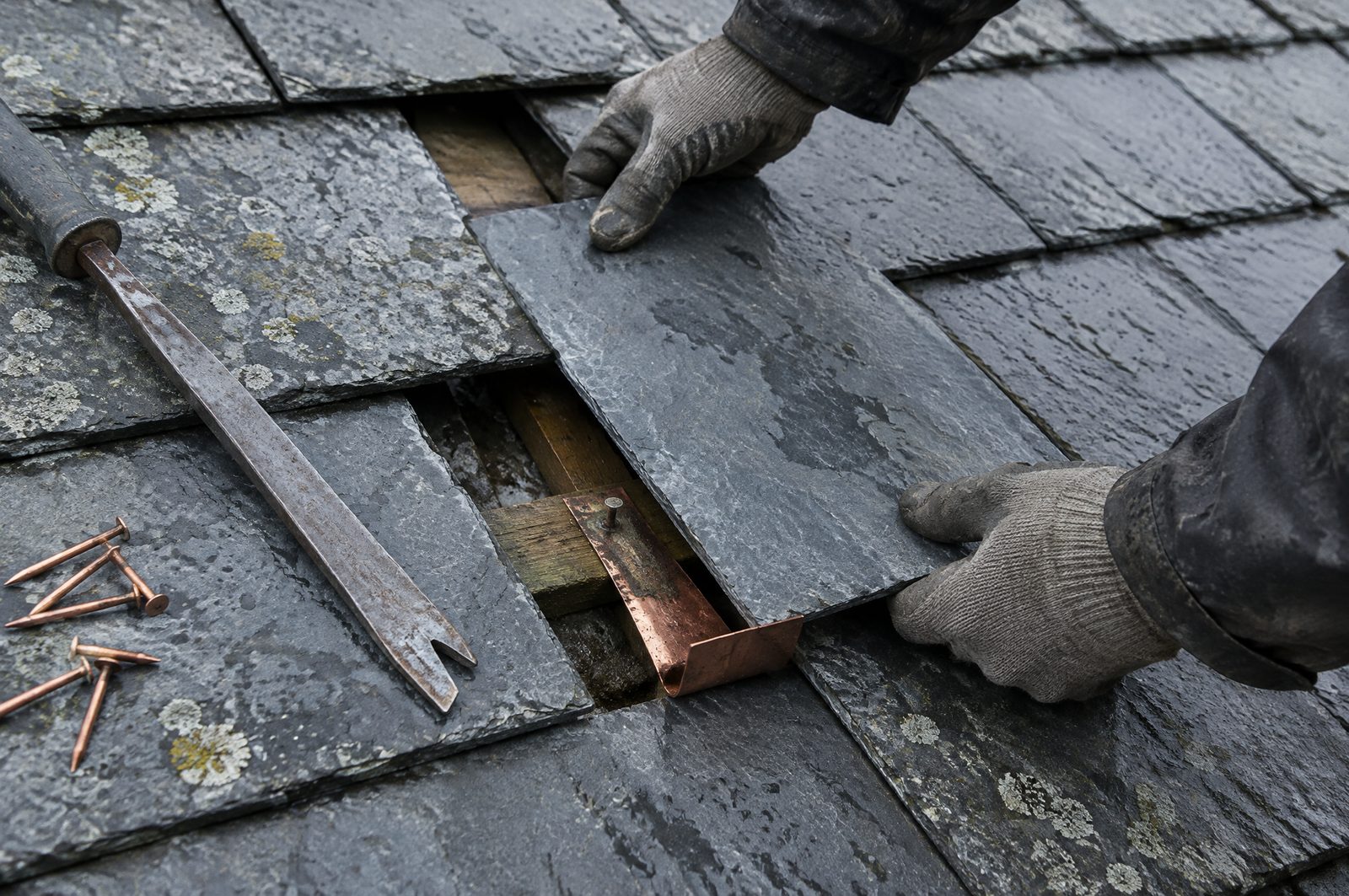
The repairs, from small to large.
Clearing. If the valley is blocked but the liner is sound, it is cleared by hand, the moss removed from the slopes either side so it does not refill straight away, and the gutter at the bottom cleared. This is often all a valley needs.
Patching. A small split in lead that is otherwise sound can sometimes be repaired by a leadworker with a lead-welded patch. Tape and sealant are not repairs; they stop the water for a season and leave a mess that has to be cleaned off before proper lead can go in.
Refixing the edges. Where the cut slates or tiles along the valley have slipped, they are lifted, recut if needed and refixed or rebedded, without touching the liner.
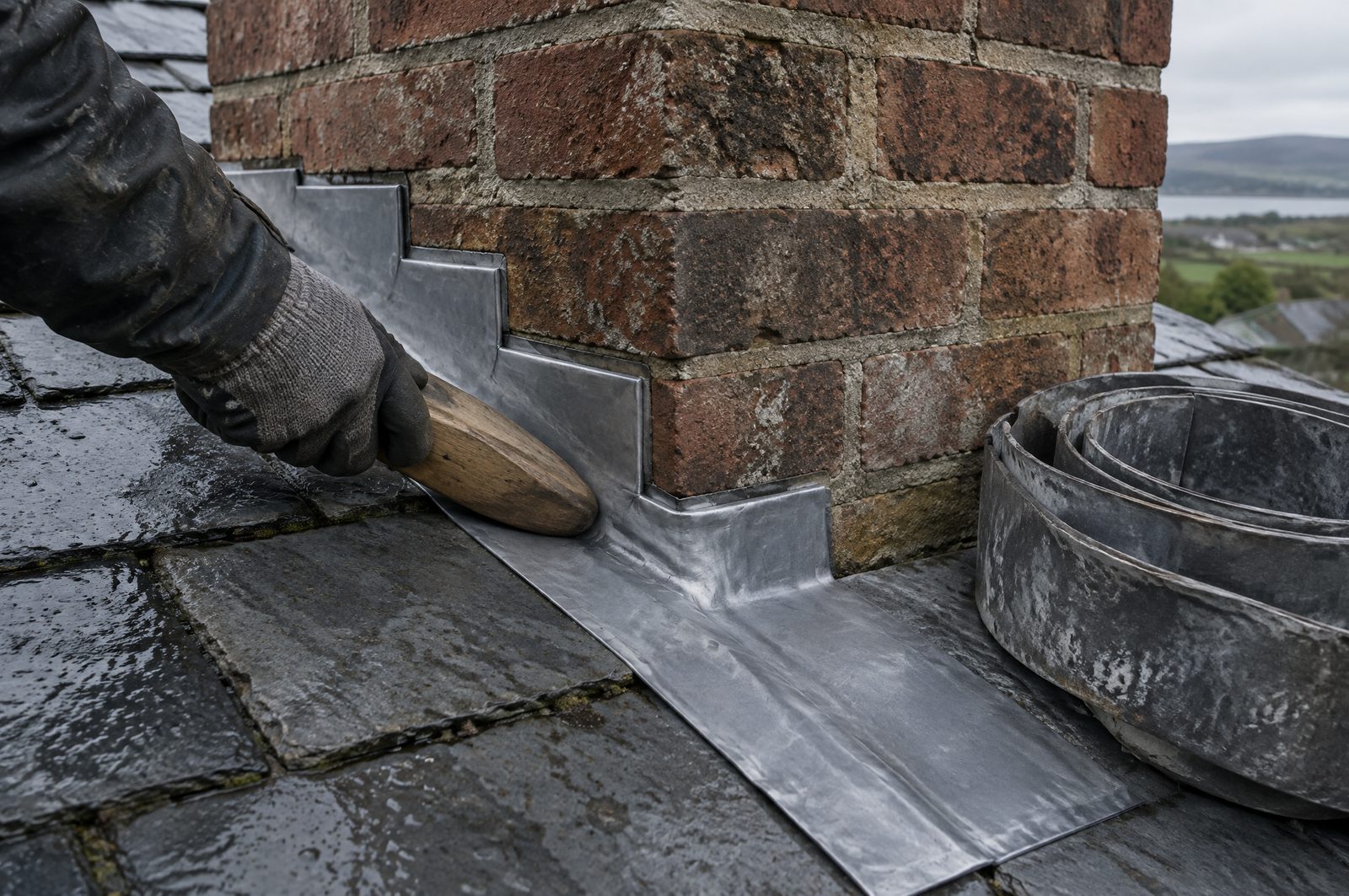
Relining. When the liner has failed along its length, or the valley boards beneath have rotted, the covering is stripped back on both sides, the old liner and any rotten boards come out, new boards and underlay go in, and a new liner is laid: milled lead in properly lapped lengths, usually Code 5 for a domestic valley, or a GRP tray matched to the roof. The slates or tiles are then cut and refixed. This is a bigger job, and on a two-storey house it usually needs a scaffold tower or scaffold.
Lead or GRP for a relined valley.
Both work when they are fitted properly. Lead can be shaped on site to suit an odd angle or a junction with a wall, lasts a long time, and suits slate roofs and older houses. GRP trays are made to a fixed profile, are lighter, and have no scrap value, which matters in areas where lead theft from roofs is a problem. We talk through which suits your roof when we look at it, and match what is there where that makes sense.
From the call to the photos.
The same crew looks at the job, quotes it and does it. You get before and after photos when it is finished.
- First01.
Send a photo of the valley.
From the ground or an upstairs window, plus a photo of any stain inside. Say whether it leaks in every rain or only in heavy downpours.
- Then02.
A look from the ladder.
A same-week look on most repair calls, with no call-out fee. We photograph the liner, the edges and the boards from the loft.
- Next03.
Free written quote within 48 hours.
Naming the repair: clearing, edge refixing or relining, the material, and any access equipment included.
- Last04.
Repair and photos.
The valley is repaired and you get before and after photos on completion, taken from the same spot.
Repairs, not re-roofs.
We repair valleys on pitched slate and tile roofs across Dublin, Wicklow and Kildare, including clearing, edge repairs and full relining in lead or GRP. We do not re-roof. If the valley problem is one sign of a roof that has failed throughout, we will tell you with photos and refer you to a re-roofing contractor.
Questions people ask.
Anything else, ring 085 781 4603.
Can a leaking valley be fixed without relining it?
Often, yes. Many valley leaks are a blockage or a slipped edge slate, and clearing or refixing stops the water. Relining is for a liner that has split along its length or boards that have rotted underneath.
Is lead or GRP better for a roof valley?
Neither is better on every roof. Lead suits slate and older roofs and can be shaped on site; GRP is lighter, fixed in shape and has no scrap value. Both last when they are fitted correctly.
What code of lead is used in a valley?
For a domestic valley, Code 5 lead is commonly used, laid in lengths of about one and a half metres with laps running downhill. Heavier codes are used on exposed sites or large valleys.
Why does my valley only leak in heavy rain?
Usually because it is partly blocked or too narrow. In light rain the water gets past; in a downpour it backs up over the edge of the liner and under the slates. Clearing the valley is the first thing to try.
More on roofing.
Or go back to the main roofing page.
Want us to take a look?
Send a photo from the ground if you can, or we come out and look from the ladder. One written price inside 48 hours, no call-out fee and no pressure to go ahead.