Lead flashing repair: what fails and how it is fixed.
A lead flashing is repaired by working out whether the lead itself has failed or only its fixing, then either re-securing it in the mortar joint or cutting it out and dressing in new milled lead. Flashings seal the joints where a roof meets a wall, a chimney or a dormer, and they are behind a large share of roof leaks. This guide explains the parts of a flashing, how each one fails, and what a proper repair looks like.
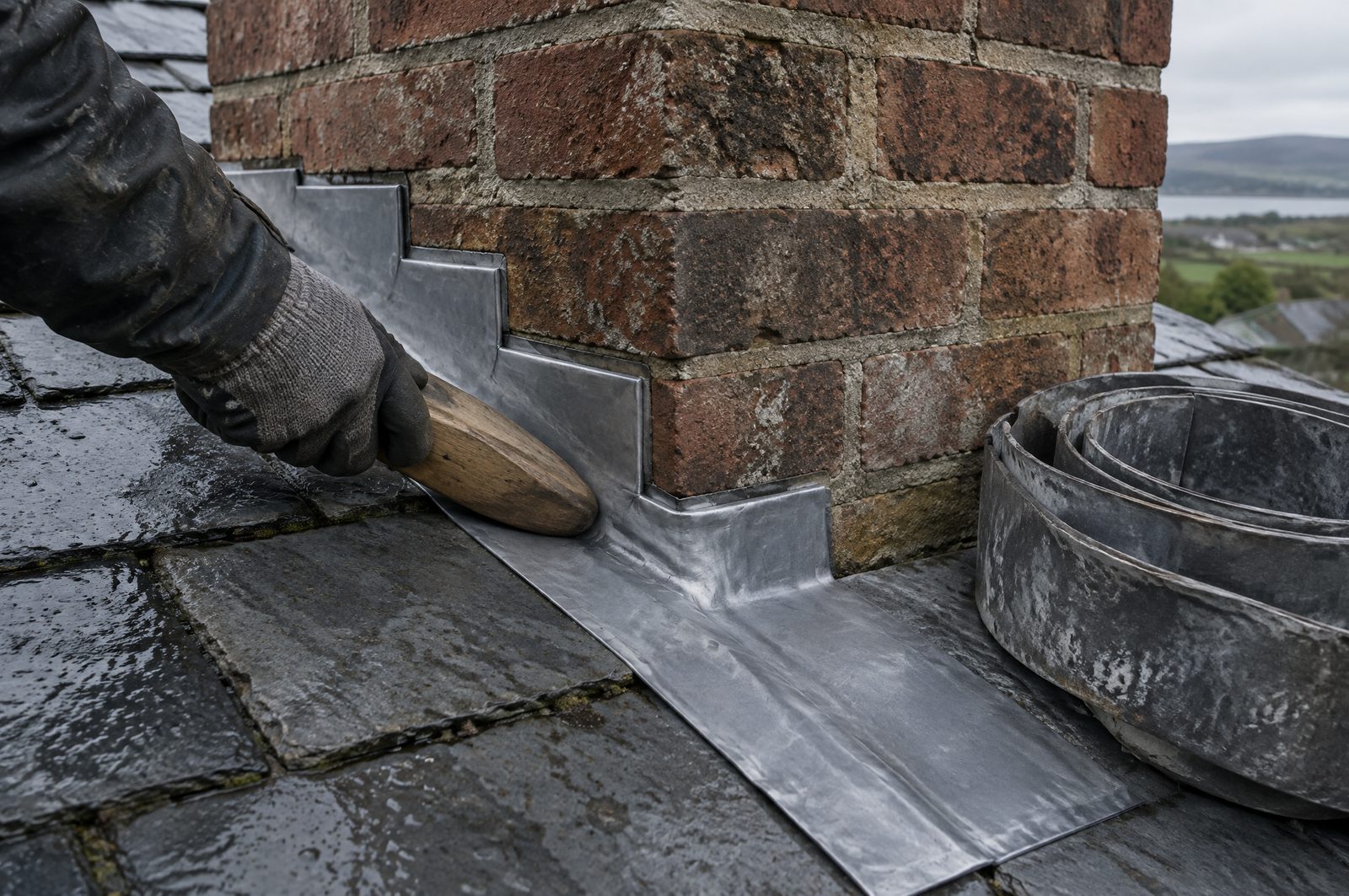
Lead flashing is the weatherproofing at the junctions: where the roof meets a chimney, a wall, a dormer or a pipe.
It leaks when the mortar holding it in the wall falls out, when the lead cracks from age or from being laid in lengths that are too long, or when someone has sealed over it instead of fixing it.
A loose flashing in sound lead can be re-wedged and repointed; cracked or thin lead is replaced with new milled lead, usually Code 4 for flashings, chased into the joint and dressed to the roof.
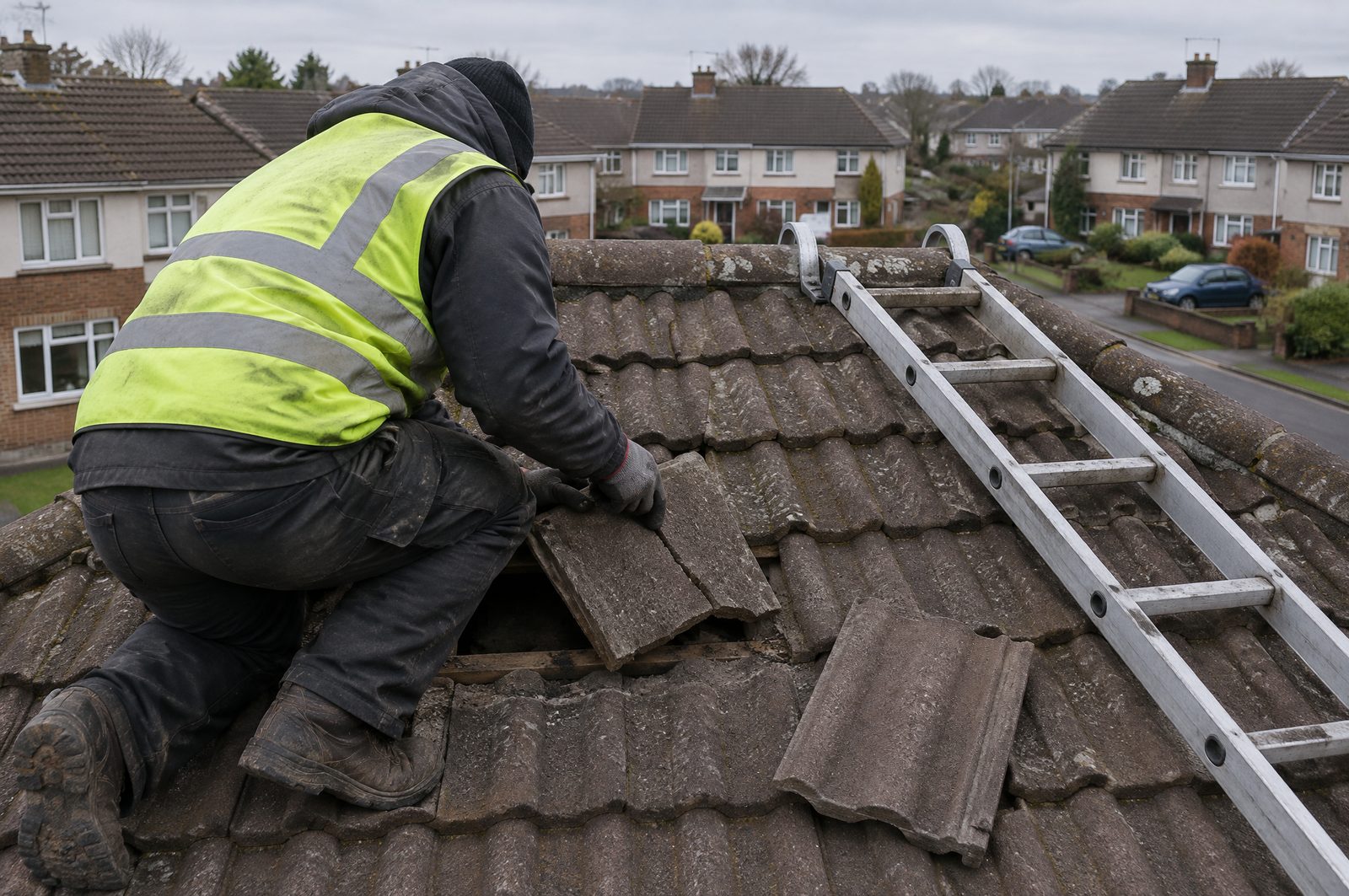
The parts of a flashing.
A flashing is not one piece. Where a sloping roof runs up against a wall or a chimney, it is made of layers that work together.
- 01Soakers: small pieces of lead slid under each slate or tile along the wall, turned up against the brick
- 02Step flashing: a cover flashing cut into steps that follow the slope, with each step tucked into a mortar joint
- 03Cover or counter flashing: a strip chased into a mortar joint and dressed down over the soakers or the upstand
- 04Apron flashing: the piece across the front of a chimney or along the bottom of a wall, dressed down over the slates or tiles below
- 05Back gutter: a lead-lined channel behind a chimney that carries water round the stack
- 06Pipe and vent flashings: a sleeve or slate around anything that comes up through the roof
Lead codes, in plain terms.
Rolled lead sheet is sold by code, which is its weight and thickness. The higher the code, the thicker the lead. Code 3 is light and used for soakers. Code 4 is the usual choice for step flashings, cover flashings and chimney work. Code 5 is used for wider aprons, back gutters and valleys. Codes 6 and above go into gutters, flat roofs and exposed or heavy-duty work.
The thicker codes are not always better. A heavier lead is stiffer to dress round a junction. What matters is the right code for the job, laid in the right lengths. Lead guidance limits a flashing chased into a wall to about one and a half metres per piece, lapped to the next, because longer pieces cannot cope with expansion and contraction and crack.
How lead flashings fail.
The mortar goes first. A cover flashing is held in a raked-out mortar joint with lead wedges and then pointed. Over the years the pointing cracks and falls out, the wedges loosen, and the flashing lifts away from the wall. Rain runs down the brick, behind the flashing and into the roof. From the ground it shows as a strip of lead standing off the wall, or a dark gap along its top edge.
Then the lead itself. Lead moves with every warm day and cold night. A piece that is too long, nailed tight, or held at both ends has nowhere to go, and it cracks along a fold or at a fixing. Old lead also thins over decades, and lead that was too light for the job in the first place splits sooner.
Then the bodges. Flashings that have been patched with mastic, bitumen paint, foil tape or a fillet of cement are common. Cement cracks away from both the brick and the slate. Sealant holds for a season and then lets go. Each layer makes the eventual repair harder, because all of it has to come off before new lead can be dressed in.
Lead also gets stolen, especially the more visible pieces on extensions and bay roofs. If lead has gone missing, the replacement can be lead or a lead-substitute flashing, and that is a conversation worth having.
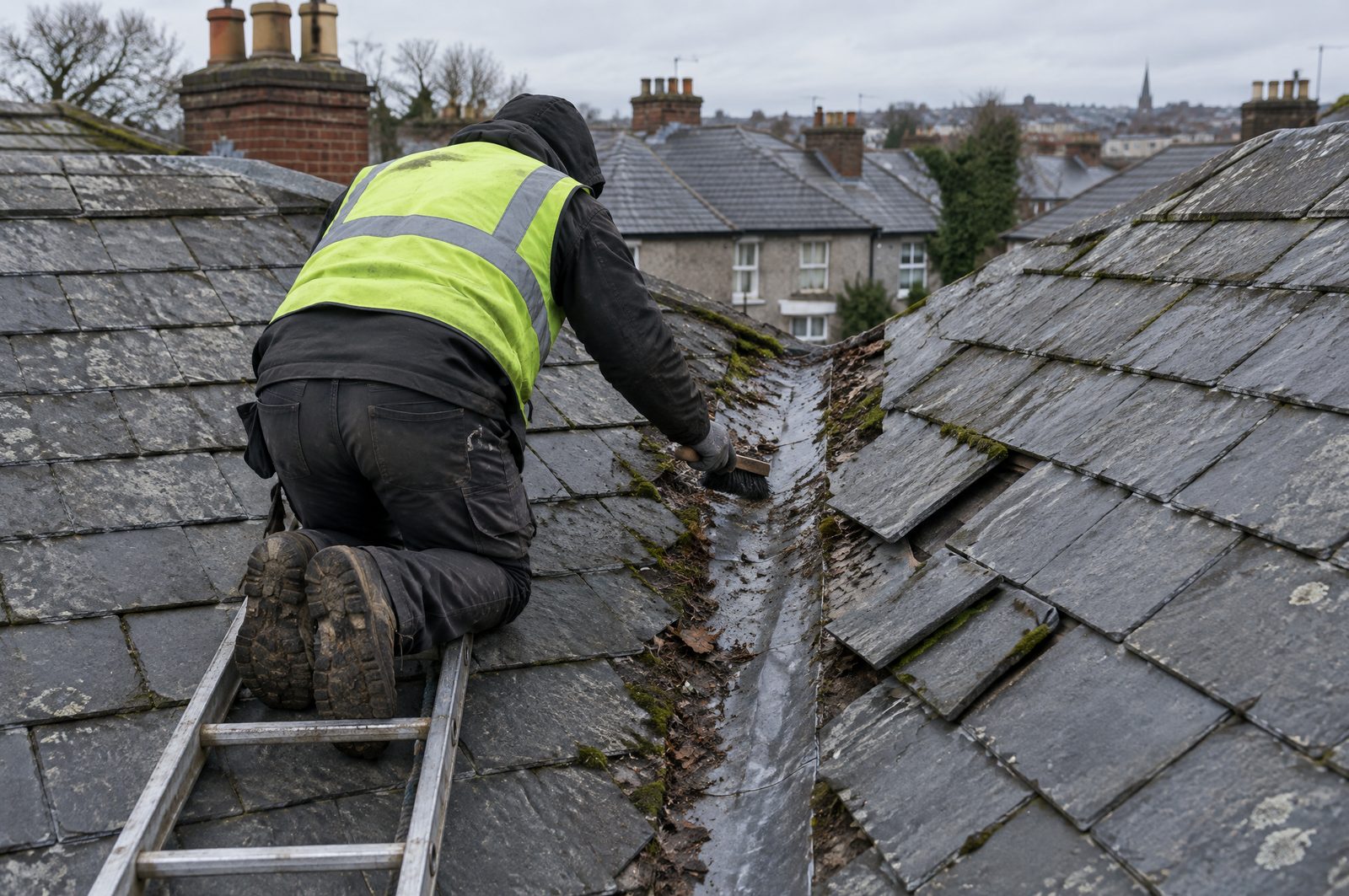
Signs your flashing needs attention.
Look from the ground, with binoculars or a phone camera zoomed in.
- 01Lead standing away from the wall or chimney, or a gap along the top edge
- 02Pointing missing from the joint the lead is chased into
- 03Splits or cracks in the lead, often at folds and corners
- 04Black mastic, tape or cement smeared along the flashing
- 05A damp patch inside on the wall or ceiling beside a chimney breast or where an extension roof meets the house
- 06White staining running down the slates or tiles below new lead, which is harmless lead carbonate but shows the lead was not treated
What a proper repair looks like.
If the lead is sound and has only pulled out of its joint, the joint is raked out, the flashing pushed back into the chase, re-wedged with lead wedges and repointed. That is a small repair and it should last.
If the lead is cracked, thin or covered in old sealant, it is cut out and replaced. The joint is raked out to depth, new milled lead is cut and dressed to the shape of the junction, soakers are checked or renewed under the slates, the cover or step flashing is wedged into the chase, and the joint is pointed. The lead is then treated with patination oil, which stops the white staining washing down onto the roof below. Any slates or tiles lifted for the job are refixed.
The quote for this should say which flashings are being renewed, what code of lead is used, and what access is included. On a chimney or a two-storey wall, that usually means a scaffold tower or scaffold.
From the call to the photos.
The same crew looks at the job, quotes it and does it. You get before and after photos when it is finished.
- First01.
Send a photo of the flashing.
From the ground, zoomed in if you can, plus any damp patch inside. Say which wall or chimney it is.
- Then02.
A look from the ladder.
A same-week look on most repair calls, with no call-out fee. We photograph the lead, the joint and the soakers close up.
- Next03.
Free written quote within 48 hours.
Re-wedge and repoint, or renew in new lead, with the code of lead and the access written down.
- Last04.
Repair and photos.
The flashing is repaired and you get close-up before and after photos on completion.
Repairs, not re-roofs.
We repair and renew lead flashings at chimneys, walls, dormers and extensions on pitched slate and tile roofs across Dublin, Wicklow and Kildare. We do not re-roof, and we do not lay new lead flat roofs. If the flashing problem turns out to be part of a roof that has failed throughout, we will tell you and refer you on.
Questions people ask.
Anything else, ring 085 781 4603.
Can a lead flashing be repaired, or does it need replacing?
If the lead is sound and has only pulled out of the mortar joint, it can be re-wedged and repointed. If it is cracked, thin or covered in old sealant, it is replaced with new lead.
What code of lead should be used for a chimney flashing?
Code 4 is the usual choice for step and cover flashings at a chimney or wall, with Code 3 for soakers and Code 5 for wider aprons and back gutters. The quote should state the code.
Is it all right to seal a flashing with mastic?
Not as a repair. Sealant fails within a season or two and has to be cleaned off before new lead can go in. It is acceptable in a few places as part of a proper detail, not as a substitute for one.
Why is there white staining on my roof below the new lead?
That is lead carbonate washing off untreated new lead. It is harmless and fades, but it is avoided by treating the lead with patination oil when it is fitted.
More on roofing.
Or go back to the main roofing page.
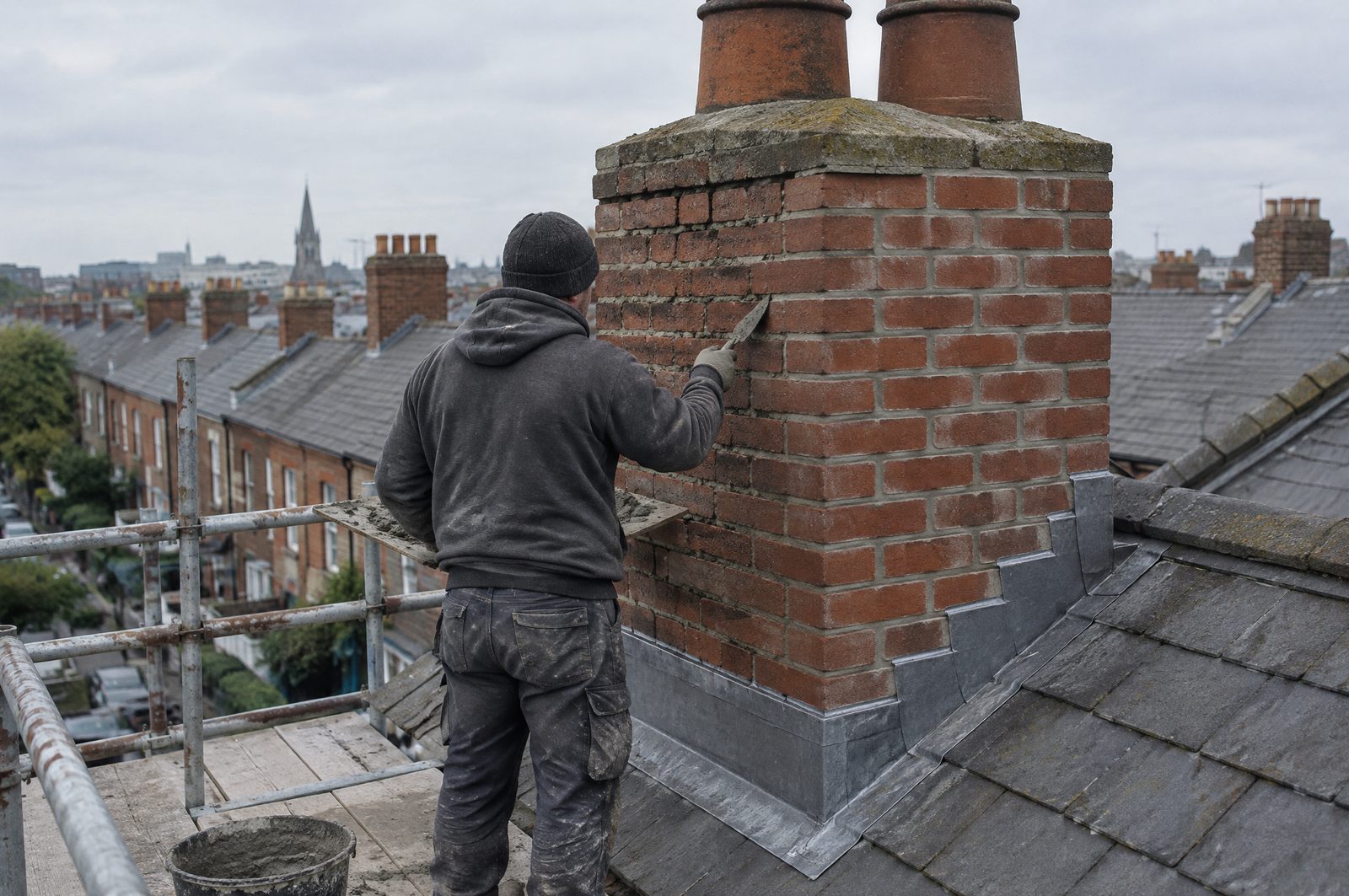
Want us to take a look?
Send a photo from the ground if you can, or we come out and look from the ladder. One written price inside 48 hours, no call-out fee and no pressure to go ahead.